Private equity’s AI reckoning has nothing to do with technology



Private equity’s AI reckoning has nothing to do with technology
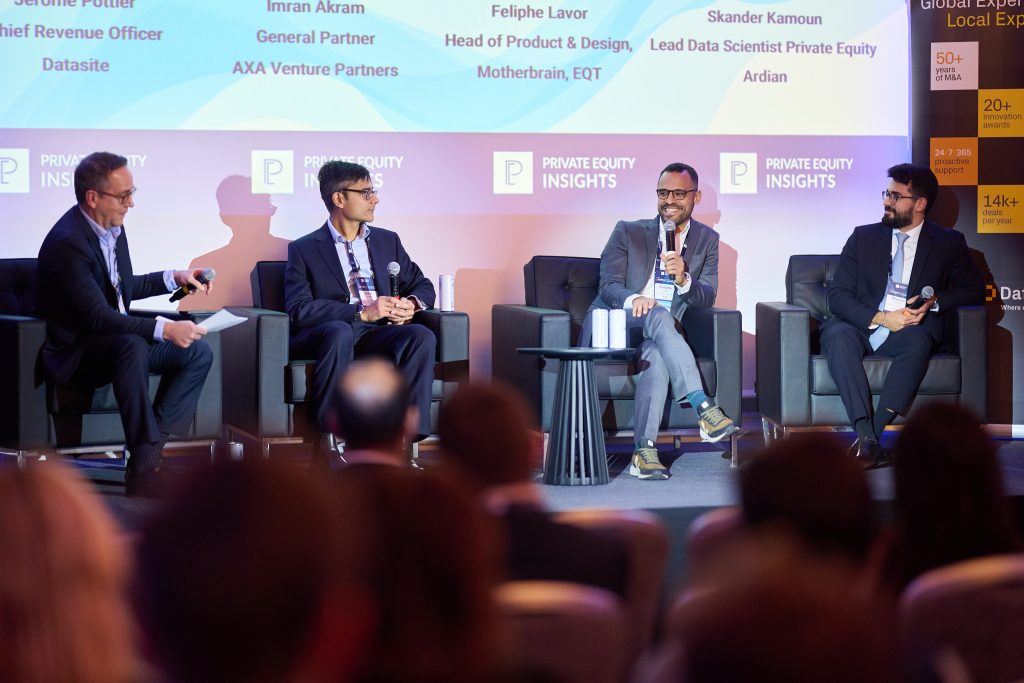
That tension was explored at the London Private Equity Insights Conference by senior investors from AVP (formerly AXA Venture Partners), EQT, and Ardian, in a discussion moderated by Jerome Pottier. The recurring theme was focused on behaviour and how decisions are justified within the wider organization.
Imran Akram, General Partner at AVP started by explaining that for much of his career, value creation involved “spending a lot of time going through lists of companies and conferences and checking data and doing all the sort of low-level work.” AI’s first impact has been to remove that burden. Feeding large volumes of information into a machine and asking it to surface risks or priorities is now a routine exercise. “It makes so much more sense to feed it to a machine to go and read it and tell you “look, actually, here are the five things you should look at”,” said Akram.
What is more revealing is what happened when these systems started working well. Akram described internal tools that identified relevant opportunities with a hit rate of around 30%, which is unusually high by private equity standards. Yet many professionals ignored them. “People are not spending their time in the CRM,” he said. “They just go back and do it their own way.”
At EQT, Feliphe Lavor, Head of Product & Design at Motherbrain, described how the firm’s approach to AI has deliberately moved away from ownership and permanence. Motherbrain, he said, began as a sourcing product but “became a team. And now it’s more of a mindset across EQT because nobody owns AI anymore.” Tools are built quickly, tested, and then often get discarded. “You need to keep pushing,” he said, “and be detached and throw things away.”
That philosophy runs against private equity’s instinct for polish and certainty. Lavor recounted how EQT built an internal system that could extract company names from bankers’ decks by recognising logos with around 90% accuracy. Within weeks, a new external model made the tool obsolete. “Should we have done this in the first place?” he asked rhetorically. His answer was yes. The value lies in the learning process.
At Ardian, the focus has been less on speed and more on analytical depth. Skander Kamoun, Lead Data Scientist for Private Equity at the firm, argued that AI allows investors to underwrite risks that standard financial models cannot capture. In assets such as battery storage, revenues depend on complex, hour-by-hour dynamics. “If you try to model this with Excel, you will not be able to do it in 40 years’ time,” he said. Data science, by contrast, makes those dynamics visible and investable.
But Kamoun was also explicit about the prerequisites. “If you really want to build AI in a company and to integrate it in the process, you have to rely on clean, structured, and governed data,” he said, noting that many firms still fall short. Without those foundations, AI becomes surface-level, with impressive outputs resting on fragile inputs.
Adoption, in practice, often comes down to trust. Lavor described how a sophisticated internal tool at EQT failed simply because investment professionals wanted Excel. Usage only improved once the output was delivered in spreadsheet form. Excel remains the language in which judgement is defended.
Another complication comes with measuring impact. Many AI gains are incremental: board minutes prepared in 20 minutes instead of two hours, repetitive analysis automated, etc. Lavor noted that these improvements rarely register strategically, even though they compound over time. In contrast, the cases that attract attention are those where AI visibly shifts outcomes, such as an EV-charging business that improved charger utilisation by around 50% through AI-driven site selection.
Yet even here, the panellists resisted framing AI in terms of a single return metric. Capability matters more at this stage. As Lavor put it, “Capability development is the most important thing that we can do.”
Kamoun warned in the end that “the biggest risk is inertia,” he said, in the form of quiet avoidance. Once AI novelty fades, private equity players will have to steer clear of drifting back to familiar workflows that do not deliver the same results.
Not to worry, AI will not replace private equity investors anytime soon. But it will expose which firms are willing to adapt how decisions are made and challenged. Those who are prepared to accept impermanence and let machines question their instincts occasionally will carry an advantage.
by Andreea Melinti
If you think we missed any important news, please do not hesitate to contact us at [email protected].
Can`t stop reading? Read more.